
It has been over two and a half years since my last personal essay! I’ve since joined and left a women’s publication, started using colons, and no longer leave spaces between my—frankly, excessive amount of—em dashes. The most meaningful writing I’ve worked on was for Jom Media, a local online magazine that practices slow journalism and focuses on stories often overlooked by mainstream media. I’ve written two long-form essays so far and true to form, each feature piece took about a year to come to fruition.
Mutual aid in Singapore: where solidarity looks like charity
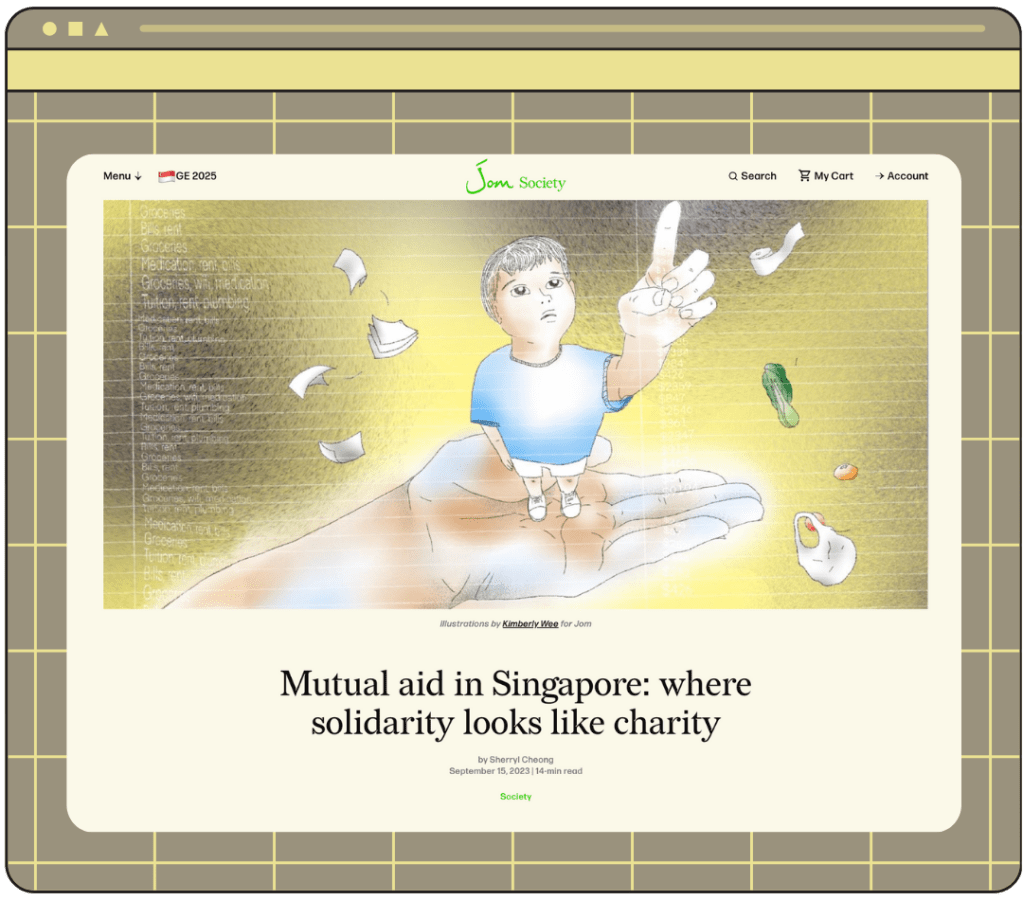
Back in October 2022, I summoned the courage to respond to Jom’s call for contributors even though I had no prior experience in journalism. The most relevant writing sample I could provide was my essay on cancel culture and being woke in Singapore. But I was determined to pitch the topic of mutual aid. When it first gained prominence during the pandemic, I approached my main interviewee, Odette, thinking I could interview them for an article on wildchild. Back then, I published an article once a week, and I quickly discovered that it was rather difficult for me to do the subject matter justice with just a week of preparation. After all, substantial research and thoughtful analysis could only be done with more time. I also believed I would benefit from feedback from an experienced editor. So, I put it on the back burner until the opportunity to contribute to Jom came along.
After a call with Sudhir, the editor-in-chief of Jom, I learned that mutual aid was already on the team’s radar, and they were looking to commission a writer. It felt like the stars aligned. When I submitted the pitch form, my logline—one-sentence summary of the article—was “on mutual aid in Singapore: before, during, and after the height of the COVID-19 pandemic.” The working title was a shorter version of the logline because I had no clear idea of what my essay would be like. I proceeded to read up across the subsequent months, from existing news articles to books like Notes from Coronavirus, Class and Mutual Aid in the United Kingdom. I did not hear back from the Jom team until mid-April 2023, when Sudhir emailed me to explain that they had missed my submission. The truth was that I could have sent a chaser, but I didn’t. It was partly because I was swamped with freelance translation gigs during those months. Still, another reason was that I doubted my ability to write a satisfactory feature piece for them—and myself. I wondered if their silence was my ticket out of doing something I wanted but also secretly feared. After I reconfirmed my availability and interest, they sent me a collaborator agreement, which I had to sign immediately. There was no backing out now.
Since my essay focused on Wares’ mutual aid initiative, I emailed the main organizer, hoping they would be open to speaking with me. Although I was met with silence, I was also fortunate to have secured video interviews with Odette and Irie, two active participants in mutual aid. They were both so incredibly generous with their time and energy. Odette even kindly made edits and left some comments on my first draft, as if we were working on a group assignment. The Jom team also provided helpful line edits and cut some redundant parts to improve the essay’s pacing.
Yet when the piece finally went up in September 2023, I didn’t feel as accomplished as I thought I would. I regretted the blurb I’d hastily submitted, which came directly after my essay: “Sherryl Cheong is a Singapore-based writer who is invested in telling stories that shine a light on our rich inner worlds. As a fan of creative nonfiction, she is always looking to glean insights from her emotions and experiences.” At the time, I believed it highlighted my inexperience because I couldn’t list any other notable publications. The second line also seemed out of place since I didn’t include anything personal in the essay. On an intellectual level, I understood that everyone had to start somewhere, and this was my attempt to get my foot in the door. Still, I just couldn’t shake off the feeling that I was too green and unqualified.
It was always obvious to me that I wanted to contribute to a publication like Jom because I was seeking legitimacy. I wanted to be taken seriously as a writer. I wanted to prove that I could emulate the writers whom I respected the most. Back then, writing about socio-cultural issues was the only way I dared to take up space online without shame, which is a mindset that I’ve been trying to unlearn. Since I never received any formal training as a journalist, I wanted to learn from those who were more experienced than I was. This opportunity gave me a glimpse of what it was like to work with a proper editorial team, and also revealed my latent desire to be perceived as a writer.
The untold struggles of single parents in Singapore
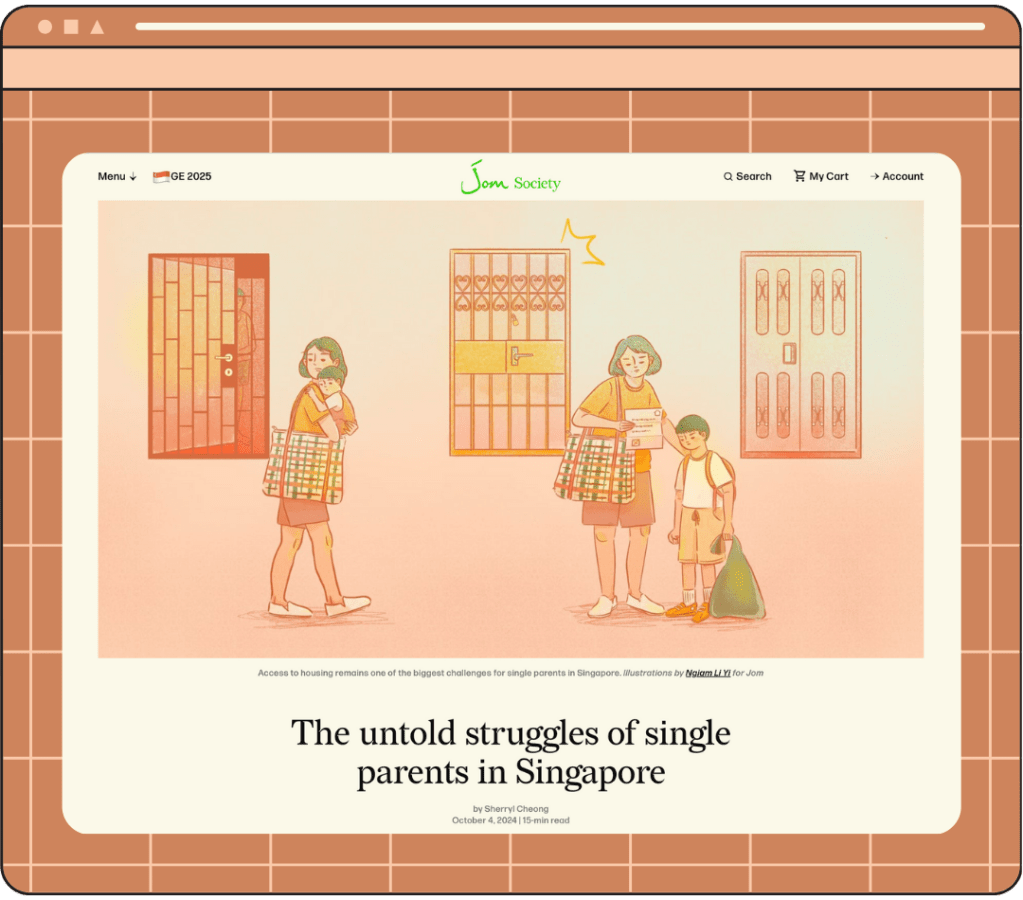
Soon after that essay went live, Sudhir told me his team would like to commission me for another. A reader had reached out to them, hoping they would shed light on the challenges unwed mothers face when applying for public housing. As an unwed mother and her child were not recognized as a family nucleus, they were only eligible for the Joint Singles Scheme, which required both parties to be at least 35 years old. I hesitated to cover this because I was not particularly well-versed in Singapore’s housing policy. After some thought, I decided to accept the pitch. It felt like a natural extension of my previous essay because it explored the struggles faced by another vulnerable community. As my mother was briefly unmarried, this essay would also be an entry point for me to weave personal narrative with societal critique.
The path forward was murkier than it was for my first essay: I had no leads or interviewees lined up. I began by reaching out to organizations that support women, but was unable to contact Daughters of Tomorrow or the team behind AWARE’s #asinglelove campaign. Fortunately, a friend connected me with someone working at AWARE, and I was eventually put in touch with their advocacy and research team. I liaised with Elizabeth, a project manager, who facilitated a video call with my first single mother, Diana. It was memorable because she was the very first—and to date, only—person who cried during my interviews. She broke down while reciting a hurtful line her daughter had said, “Ma, your life decisions are affecting me.” I knew at once that I had stumbled upon something honest, something important. Guilty about making her relive her hurt, I did the first thing that came to mind, which was to share my positionality to assure her that I was not simply mining her story for content.
Still, it was only after I interviewed Vivian Pan, the founder of the Single Parents’ Support Group, that I knew how my essay would unfold. I had stumbled upon the group’s Facebook page because it was on the first page of Google when I searched “single parents singapore”. Then, I reached out to ask if she would like to share her experiences as a single parent and her advocacy work. It was during our video call that she told me about Rebecca Loh, a single mother who killed her son after pushing him out of their five-storey flat. He had special needs, and she believed that he would be better off in a children’s home. This tragedy spurred Vivian to create the Single Parents’ Support Group. She hoped to prevent other single parents from taking such drastic measures to care for their children. It was a noble cause, but her journey was fraught with difficulties. Within the first few years of running the group, Vivian was accused of scamming donors through a fundraising campaign that gained considerable traction.
After speaking with her, it became clear that my essay had to expand beyond housing. I wanted to offer more glimpses of what it was like to be a single mother by focusing on my interviewees’ experiences and emotions. Along the way, I still had to kill some darlings when they did not contribute to the narrative I was trying to craft:
[When she founded the Single Parents’ Support Group], Vivian had already experienced living as a single mother for over four years. Even though the divorce was finalized when her son was three years old, Vivian’s marriage was in peril long before he was born. Her husband had a string of affairs and went in and out of jail for drug abuse. He was often drunk too. When she got home from work in the evenings, she would peer into their kitchen from the car park to see if the apartment lights were on. If they were, she would call home. She wanted to assess his sobriety discreetly, to be able to mentally prepare herself for the version of him that awaited her. Sometimes, he stole beers. Vivian remembers swallowing her pride and begging the staff members at a supermarket, “Could you please give us a chance?” Across the years, Vivian became a regular visitor at the Queenstown Remand Prison. The officers recognized her because she stood out from the crowd with her growing belly. Vivian chose to end the marriage because she knew that things wouldn’t change for the better. But even when they were in the middle of the divorce proceedings, she remained hopeful that they might. Then, when Vivian became a single parent, she sank into depression.






While working on that essay, I also stumbled upon a job opportunity in data annotation. I wound up submitting my resignation letter before receiving the final written offer because the sooner I left, the more time I would have to finish my first draft. For two weeks, I devoted all my time to writing, stopping only for meals. I compulsively drafted outlines of my essay and of other essays I hoped to emulate. I tried tracking my progress—“2 May: Wrote the first paragraph of Section 5. 3 May: Rewrote the first paragraph of Section 5.”—but eventually stopped because the exercise became too demoralizing, especially when my progress faltered when I caught Covid.
Right from the start, I struggled with the essay’s structure because the topic felt too broad. The title mentioned single parents, but I only managed to speak to single mothers. Since I had to keep within 4-5k words, I could only scratch the surface of the issues that they faced. The feedback for my first draft left me stumped. I found it difficult to incorporate women’s reproductive rights, Singapore’s approach to family planning from the 1960s onward, and regional attitudes towards single parenting without disrupting the structure I had worked so carefully to craft. Eventually, I gave up and told the Jom team they could restructure the essay as they saw fit and add any paragraphs they felt were necessary. After they got back to me with the edits, I was relieved to see that there were no major additions and that the essay still felt like mine.
When I re-read these essays now, I fixate on the areas I could improve: my completely remote fieldwork; the edits I’d hastily accepted without checking if they fit with the rest of my work; the sentence structure that I replicated for my concluding lines. That’s probably just how I operate as a writer who self-edits most of the time. Still, I’m glad I completed them. They feel representative of who I am as a writer, and that matters a lot to me. For substantial periods of my life, these freelance assignments were my world and it felt liberating to see them published. Now, more than a year after I last worked on anything as substantial, I can’t help but wonder if it’s time to think about where I want to go next with my writing.

Screenshots from Jom Media; cover collage by Sherryl Cheong
 wildchild
Leave a comment